Quick stats: VWs by Size and Region

Following on from a recent client request to see virtual world registered accounts by major region, here’s a quick chart visualising the findings.

The data is based on cumulative registered account data from Q2 2011 and clearly shows the dominance of Western Europe and North America. Keep an eye on South America and Eastern Europe though, with Brazil and Turkey (classified into Eastern Europe) on the rise.


KZero Services

KZero Reports

KZero on Facebook

Some Monsters are for Nurturing, some are for Fighting

Leading UK virtual world Moshi Monsters is getting a lot of the limelight at present with various brand extension strategies such as toys, tv and music. Hot on their heels are Bin Weevils, going from strength to strength from a user acquisition perspective. Now there’s a new contender in the mix, or rather a Monster – Fight My Monster.

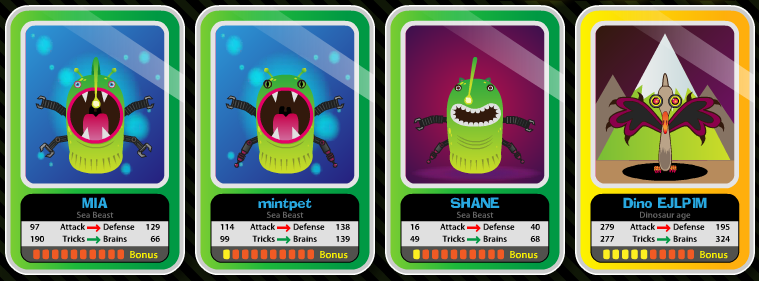
Whereas Moshi Monsters leverages a core play mechanic of Nurturing (definition:Interested in looking after their avatar and pet if applicable. Likely to be younger boys and girls, plus older girls), Fight My Monster focusses on pvp battles adopting a trading card style mechanic. Of course, like most other worlds and online games in this demographic there’s also a raft of mini-games.
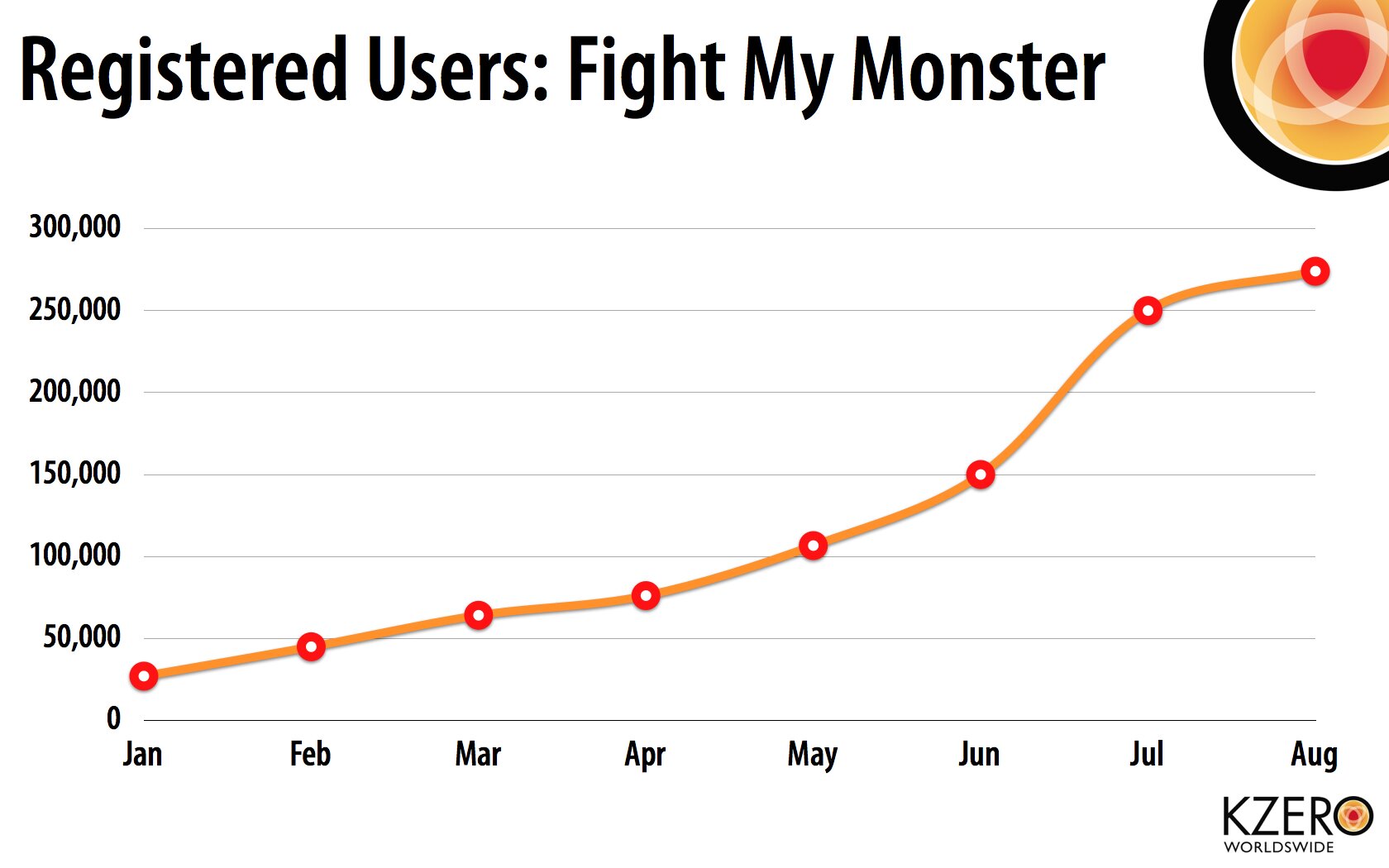
Fight My Monsters is growing relatively quickly, up to 300k users since their launch in Jan 2011 (91% from the UK). The chart below shows registered account growth (summer holidays are always good for acquiring users in the KT space).
Average session lengths are also on the rise, indicating a strengthening user engagement relationship. Continue reading “Some Monsters are for Nurturing, some are for Fighting” »

Age profiles: Chimpoo, Poptropica and Stardoll

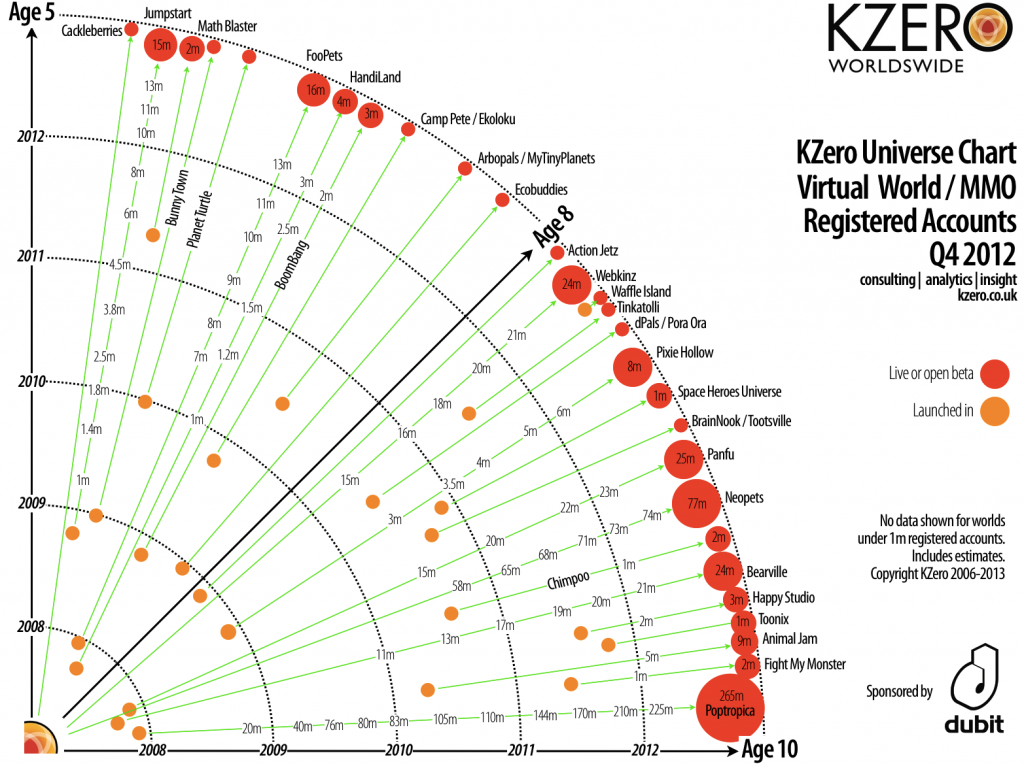
This is the second post in this series looking at age profiles of popular virtual worlds (the full report is the next post). This post looks at two of the largest worlds, Poptropica and Stardoll, along with an ‘up and comer’ in the form of Chimpoo.

Stardoll has over 116m registered accounts with a user base pretty well distributed between North America and Europe. Poptropica has over 170m registered accounts and is strongest in the US. Chimpoo has 4m registered accounts with a user base largely from India. Here are the age profiles for these three worlds.
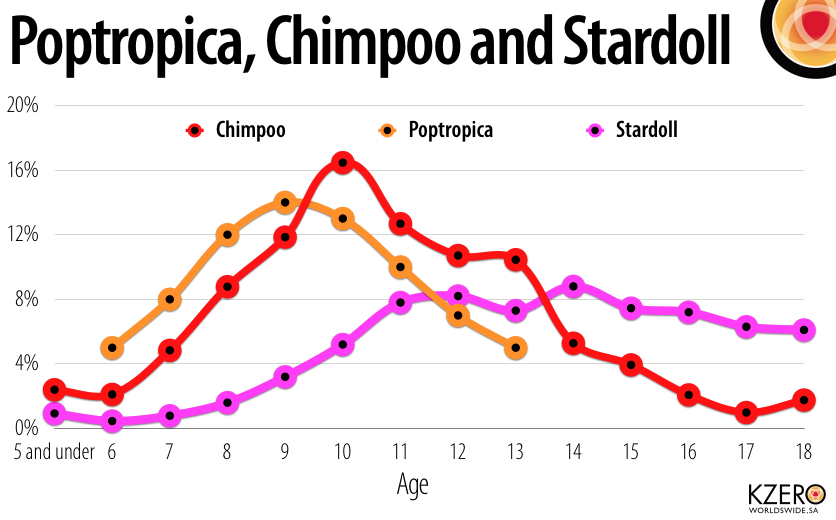
This chart highlights the impact that different play patterns and user experiences have on the ages of users inside virtual worlds.

For example, Stardoll is primarily dress-up, with users (predominantly females) customising their avatars with clothing. This is an evergreen play pattern, appealing to tweens just as much as teens.

As this post from 2008 shows, Stardoll even resonates with the Mothers of users, with over 60% playing Stardoll alongside their children and of this group, another 60% visit Stardoll without their children. Continue reading “Age profiles: Chimpoo, Poptropica and Stardoll” »

Age profiles: Moshi Monsters vs Bin Weevils

We’re a few days away from releasing our latest report on user age profiles in the Kids, Tweens and Teens virtual worlds market. So, in the meantime, here’s a look at two UK-based worlds gaining significant traction – Moshi Monsters and Bin Weevils.

Our age profile analysis visualises the ages of registered users in a simple to understand chart. First up – Moshi Monsters. The chart below compares 2011 data.
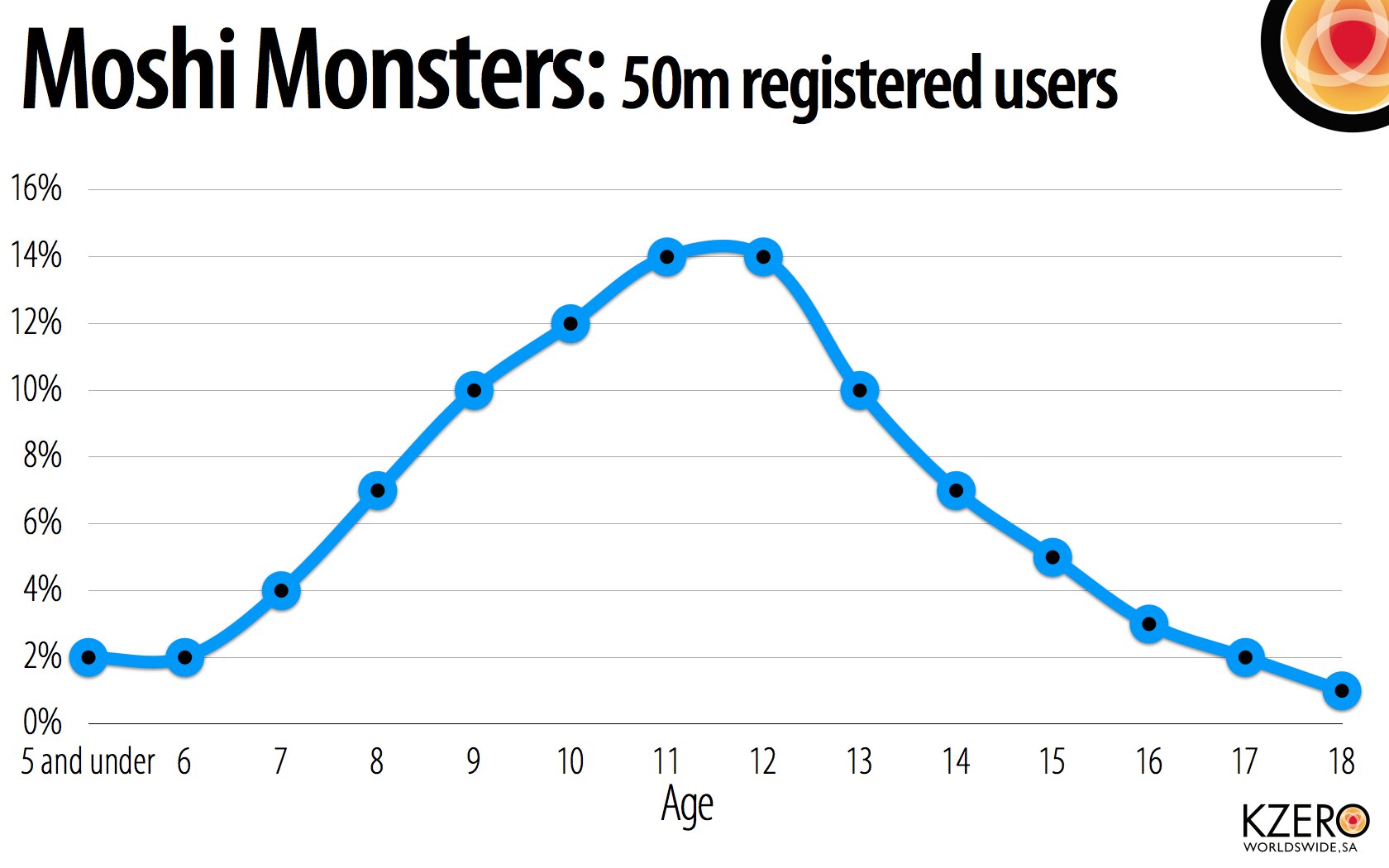
The sweetspot user age is 11 to 12, showing a one year increase from last year, indicating that Moshi is doing a great job with user retention – not surprising given the amount of brand-driven marketing they’ve been doing.

The profile has also widened slightly from last year into younger ages. As this brand continues to grow, the virtual world element becomes part of a larger brand framework and therefore kids are interacting with Moshi via multiple touch-points.

This ‘widening’ might also be as a result of increased efforts in the US. Year on year, the US element of their userbase has proportionately grown against the UK. The chart below shows the top eight countries for Moshi Monsters. Continue reading “Age profiles: Moshi Monsters vs Bin Weevils” »

Slideshare presentation of Q2 2011 Universe chart

KZero Universe Q2 2011
View more presentations from KZero Worldswide

KZero services:

Strategy

Business Planning

Marketing/Media

Product Development

Kids virtual world popularity across the EU

Here’s the master summary of the Dubit research looking at kids virtual worlds. The countries included in this research were: UK, France, Germany, Holland, Sweden, Finland, Norway and Denmark.

Below is the summary slide ranked by the % of the sample that has played/registered each world.
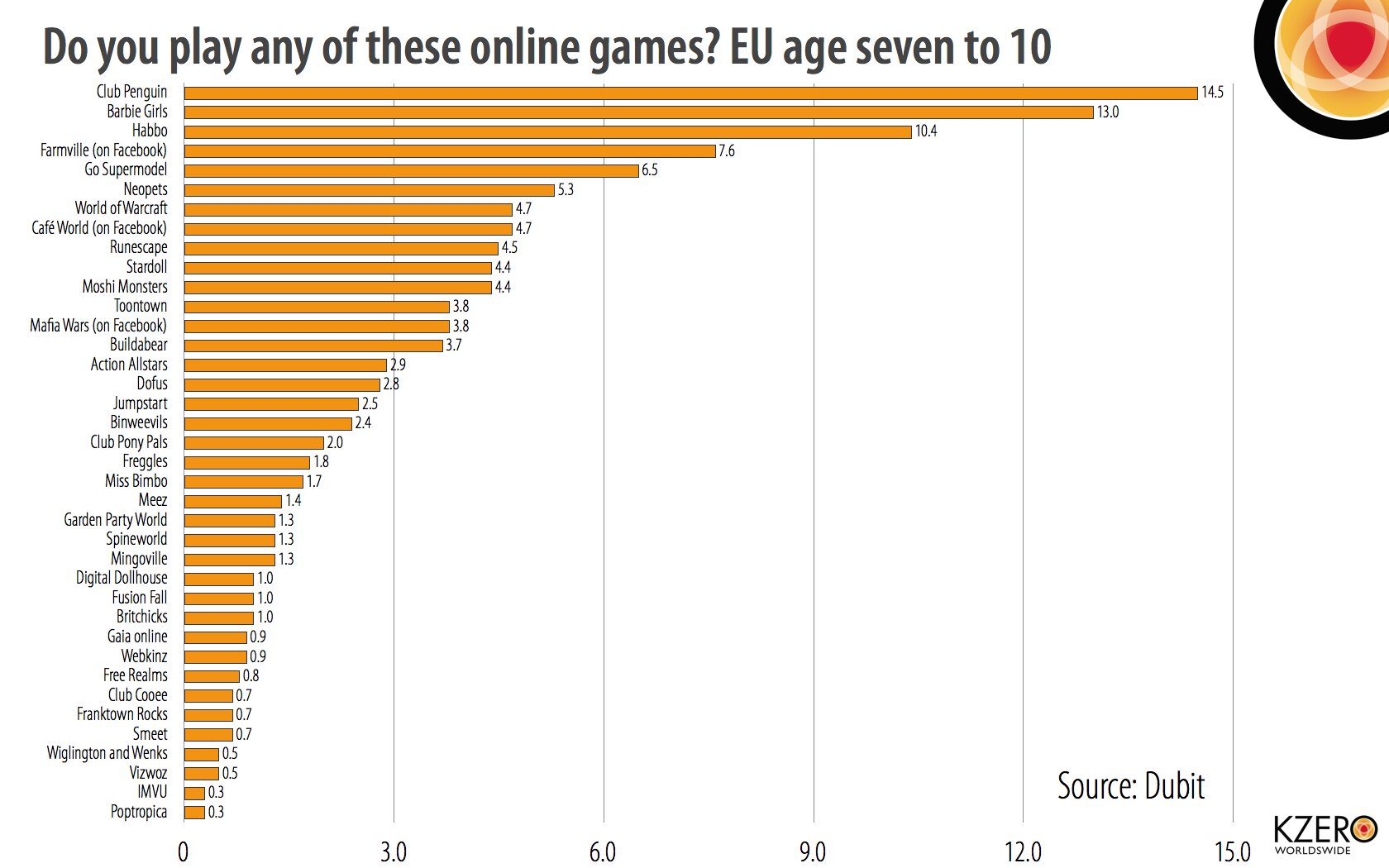
dubit eu allClub Penguin comes out top with 14.5% of the sample having played it. Second place goes to Barbie Girls with 13% with Habbo in third. Interestingly GoSupermodel beats Stardoll based on this research, albeit by a couple of % points.

Looking at this EU summary from a company-location perspective… Continue reading “Kids virtual world popularity across the EU” »

Virtual world popularity in Germany

This post examines the German marketplace for kids aged seven to 10 and the virtual worlds they claim to have used/played. The first post in this series covers the UK and the second France.

The chart below presents the findings.

dubit germany

Barbie Girls came out top in France and this is also the case in Germany, with 10.7% of the sample indicating usage. Club Penguin is in second place, tieing with World of Warcraft (which didn’t make a dent in the UK or France numbers). GoSupermodel and Jumpstart are in fourth and fifth position respective. Continue reading “Virtual world popularity in Germany” »

Virtual world popularity in France

Following on from our first post looking at the popularity of virtual worlds across the EU, starting with the UK, this post focuses on France. Dubit used a total sample size of 1,145 kids aged seven to 10. The data-points in the charts refer to the percentage of kids in the sample who indicate they have played/registered each virtual world. The sample was given a reasonable comprehensive list of major virtual worlds.

So, here’s the chart for France.

dubit franceWhereas Club Penguin is the most popular virtual world in the UK, in France Barbie Girls comes out on top with 14.7% of the sample stating they’ve played it. Dofus, with a very strong French user base comes in at second place. The average user age for Dofus is 22, so the users featured in this analysis are at the youngest edge of the user base. Club Penguin pops in at third place for France. Continue reading “Virtual world popularity in France” »

EU VW research for kids aged seven to 10

dubit logoOur good friends over at Dubit run regular Internet usage market research into the EU market place (with North America coming soon). Their January 2010 research has been made available to us, which means they’re added to our Xmas card list. You can follow Dubit on Twitter here (for Dubit Informer) and here (for the Dubit Platform).

The entire presentation will be made available on request in a day (update: the report can be ordered here) or so and for those of you looking for a peek inside, this is the first of a series of posts digging into the data. As a side-note, most people don’t realise that the EU market is the most dominant in terms of overall users in the kids and tween sectors, with conversion rates and ARPPU’s also higher than North America. We know why – do you?

The slide shown below presents the UK marketplace for boys and girls aged seven to 10.

dubit uk all.002

Club Penguin leads the pack with a considerable advantage over the rest, although it’s interesting to observe the wide spread of worlds featuring in the UK market. UK-based Moshi Monsters comes in at second place with um, Farmville in third – obviously these kids are playing alongside an older brother/sister who is actually 13 or older right?!  (probably a topic for another post). Mafia Wars also features. The same (kids signing up at an age younger than the TOS) can be said for Habbo of course. Continue reading “EU VW research for kids aged seven to 10” »

Universe and Radar presentation

Here’s a Slideshare presentation containing our Q4 2009 Universe and Radar analysis.

Q4 2009 Radar chart: Music, Fashion and Education/Development

Throughout 2009 and certainly for the majority of 2008, almost all the focus in the KT&T virtual worlds space was in casual gaming and socialising.

Now, we’re seeing a different trend, with worlds catering towards education and development being the hotspot in terms of upcoming worlds.

The chart below shows Education/Development, Fashion/Lifestyle and Music.

kzero radar q409 seg3

You can order the full report analysing growth in the virtual worlds sector here. Our report, Virtual Worlds 2010+ details the major drivers for growth in these categories. Continue reading “Q4 2009 Radar chart: Music, Fashion and Education/Development” »

Q4 2009 Universe chart: Teens and Adults

Our last post (assessing Kids and Tweens) showed the five to 10 year old segment and 10 to 15′s grew 17.8% and 6,8% respectively from Q3 to Q4 2009. Here, we cover the older sectors and first up virtual worlds with an average age user from 15 to 25. Here’s the Universe chart.

kzero universe q409 15-25

IMVU continues to dominate this age range, growing to 46m registered accounts in Q4. One to watch in this range is French VW Dofus, with 30m registered accounts, mainly in France. Of note, IMVU now publishes active users (concurrency) live on their site (with over 100k online at time of writing this post). Continue reading “Q4 2009 Universe chart: Teens and Adults” »

Q4 2009 Universe chart: Kids and Tweens

As published in our last post, the overall market of total registered users in the virtual worlds sector reached 800m in Q4 2009. Here, we delve into the younger segmented of this market, Kids and Tweens.

Virtual worlds with an average age user between five and ten reached a total of 179m in Q4, up 17.8% from 152m. The chart below contains the Universe segment for this age range.

kzero universe q409 5-10

Commentary on this age range in terms of drivers for growth and upcoming worlds is explained in this post based on the Radar. The full report on Q4 growth containing both the Universe and Radar charts can be requested here.

Here’s the segment for the ten to 15 year old group. This segment (the largest in overall size) grew 6.8% quarter on quarter from 367m to 392m. Continue reading “Q4 2009 Universe chart: Kids and Tweens” »

Virtual world registered accounts reach 800m

For those of you not attending Engage Expo today, here’s a first look at our latest Q4 2009 virtual worlds research…… (we’ll be presenting this in the Virtual Worlds and Games by the Numbers: A look in the market research session).

At the end of Q4 2009, total registered accounts in the virtual worlds sector reached 803m. This is a 19.7% (132m) quarter on quarter increase, from 671m registered accounts in Q3. The table below breaks this out by average user age range.

vw registered accounts

Over the last four quarters on a registered accounts basis the market has almost doubled, going from 419m to 803m.

Looking at this growth by age range (the average user age), the 15 to 25 year old segment demonstrated the highest growth in Q4, representing a 65% increase from 117m to 193m. Strong performance from IMVU and Habbo drove this uplift.

Second highest growth came in the youngest age range (five to 10 year old) and as the just released Radar chart shows, this segment, in particular for virtual worlds catering to education and development is hotting up. Quarter on quarter growth in this segment was 27m, moving from 152m to 179m.

Our Universe and Radar charts have also been updated based on closing Q4 data. Here’s a post for the Universe and another for the Radar.

The full report covering growth in the virtual worlds sector can be ordered here.

Here’s (of course) a few of charts. Continue reading “Virtual world registered accounts reach 800m” »

VW User Profiles: SmallWorlds

Launched in 2008, SmallWorlds currently has over 2m registered accounts and is the next in our series of looking at age profiles for virtual worlds targeting teens and older. Here’s the age profile:

smallworlds.020 The most popular user age in SmallWorlds is 14, accounting for 14% of the total. 15 and 19 years vie for second place, with early to mid 20′s also holding their own.

Again we have an interesting mini-peak at age 29. This mini-peak can also be seen in Miss Bimbo AND Club Cooee. Hmmm – interesting. Anyone got any thoughts on this?

Here’s the cumulative chart for SmallWorlds. Continue reading “VW User Profiles: SmallWorlds” »

Avg user ages by country for Habbo

Here’s some insightful data recently released from Habbo. It shows the average user age by country. In the first chart we’ve colour-coded countries by major region. It’s almost per continent but we’ve broken out Scandinavia, for reasons well explained by the chart…

age profiles habbo.014With an average user age of 15.9, Peru tops the chart, followed by Malaysia.

Inversely, the Netherlands has the overall lowest average user age with 13, followed by Belgium.

Can we draw conclusions from this chart. That’s what the colour-coding is for.

It would appear the the Scandinavian countries combined have a low (compared to others) average user age. Let’s remember that the parent company (Sulake) is based in Finland and was launched their first in 2000. This could imply that older target market users in these countries get into Habbo at a comparative earlier age and then migrate to older worlds – they might be a little more familiar with virtual worlds than users in countries from South American for example, that combined has an older average age.

The broad conclusion here being that the lesser developed the country or region, the higher average user age. By lesser developed we mean a lower broadband and PC penetration with a generally less internet savvy population. Of course, other factors do come into play here such as awareness of specific virtual worlds and unique nuances per country.

Here’s the chart showing aggregated average ages per major region in support of this conclusion….

age profiles habbo.015

VW User Profiles: Club Cooee

Our first three posts in this series looking at age and country user profiles focused on younger worlds – Poptropica, Moshi Monsters and Jumpstart. Now we’re switching up a little, this time looking at Club Cooee. CC takes a different approach to delivering a virtual world experience by using the desktop at the platform.

Here’s the user base age profile:

cc.012The spike around age 19 is probably explained by users thinking they get additional features/services/access by indicating they’re over 18 years old.

Factoring this blip out, it’s clear that Club Cooee resonates well into early to mid teens. However, the gradual decline from this sweetspot age range shows that this world is well represented right through to the early 20′s. Continue reading “VW User Profiles: Club Cooee” »

Active VW user forecast: 2009 – 2013

‘Tis the season to release forecasts’. Well, we tend to do this all year round, but seeing as we’re fast approaching 2010, here’s some charts we usually keep wrapped up for special occasions – our active user forecast for the virtual worlds sector.

First up, the headline chart, total unique active users from 2009 to 2013.

user forecasts virtual worlds.002The 2009 year end forecast for active users in the virtual worlds sector is 136m (compared to circa 750m total registered accounts). This has been calculated by assessing the active user data we hold for a range of large (and small) virtual worlds, combined with research relating to users having accounts across multiple worlds (to take out duplicates).

We expect 2010 to be a major year for virtual world growth, both from new worlds coming to market supported by major marketing pushes, along with a pick-up in the overall economy and a continuation of increasing awareness and resonance towards the sector. Continue reading “Active VW user forecast: 2009 – 2013” »

Comparing user profiles: Poptropica, Moshi Monsters and Jumpstart

We’ve had three posts so far looking at individual user base age profiles for Poptropica, Moshi Monsters and Jumpstart. And, whilst looking at these worlds in isolation throws up some interesting data points and findings, it’s as interesting to compare all three side by side.

The chart below presents the specific age profiles for these three virtual words.

pop jump moshi 1The wider overall age spread of Moshi Monsters is clearly shown, peaking at the 10-11 spots. Poptropica follows a similar pattern to Moshi, albeit in a tighter age band.

And the penetration into younger ages achieved by Jumpstart also stands out.

The chart below shows this data on a cumulative user base basis. Continue reading “Comparing user profiles: Poptropica, Moshi Monsters and Jumpstart” »

VW User Profiles: Jumpstart

Whereas both Poptropica and Moshi Monsters have user age profiles peaked around specific ages ranges, the profile for Jumpstart, the educational world (in 3D using Unity) from Knowledge Adventure is somewhat different and shown below.

jumpstart users 1It’s more of a ridge than a peak, with ages five to nine well represented in the range of 13% to 11% of the total user base.

This spread of ages is explained by the feature-sets and positioning of the Jumpstart world, with different games and activities available in-world catering to different age groups. Continue reading “VW User Profiles: Jumpstart” »

VW User Profiles: Moshi Monsters

Following on this series of looking at the age profiles of virtual worlds (first was Poptropica), now it’s Moshi Monsters.

Moshi is a London-based VW operating by Mind Candy. Grow-wise, 2009 was an excellent year, growing from 1m to 7m across two quarters. We expect Moshi to reach 10m users when we release our Q4 numbers in early 2010. They’re marked on the Universe chart as having an average user age of ten years old. The chart below shows the age profile.

moshi users 1It’s a near perfect curve with equal distribution of ages right from three to 18. Looking at the accounts on a cumulative basis…..

Almost 50% of the users are ten and under and 80% are 13 and under.

Switching to the user locations, the chart below shows the 7m accounts by top countries.

moshi users 2 Continue reading “VW User Profiles: Moshi Monsters” »

VW User Profiles: Poptropica

In the first of a new series of posts we’re rolling up our sleeves a little and examining the user bases of popular virtual worlds in the KT&T space. The focus is on the age distribution of registered accounts along with their real-world location.

First up, Poptropica, a virtual world from Pearson that steam-rollered into the sector in September 2007. As the Universe chart shows, Poptropica experienced record-setting user base growth and currently has over 80m registered accounts.

The distribution of these 80m accounts is shown in the graph below.

poptropica users 1 The best represented age in Poptropica is ten, accounting for 14% of total accounts (that’s 11.2m registered accounts). In second place are nine year olds with 12% of the total.

There’s an interesting dip between six and eight year olds, with children who are seven accounting for 6% compared to 9% and 10% respectively for six and eight’s. Continue reading “VW User Profiles: Poptropica” »

September metrics part 3: Western Europe

Western European countries account for the largest share of the population in Second Life – although North America is showing signs of catching up (and being the lead region again).

What’s of particular interest is the segmentation and analysis of the countries comprising Western Europe. The graph below shows the % share of total SL population for these countries.

western-europe-stats005.jpg

Continue reading “September metrics part 3: Western Europe” »

September metrics part 2: A global view on SL usage

North America (primarily the USA) had been the driving force behind the geographical population of Second Life up to about May 2006, largely explained by the ‘localite’ nature of Innovators. From around this period however, a surge in Western European accounts overtook North America as the dominant region in SL. Shown below over time are the major global regions and their respective share of the active resident population.

global-second-life-user-stats009.jpg


However, although Western Europe still accounts for the largest region in SL, a clear resurgence in North American active users can be observed from June 2007.

In terms of actual numbers for September 2007, these can be seen below.

global-second-life-user-stats008.jpg

Active users residing in North America now accounts for exactly one third of all active, a 1.3% increase month on month.

But what about actual usage? The key metric here is the average number of hours spent in SL per month. The graph below shows this stat for September. Continue reading “September metrics part 2: A global view on SL usage” »

September metrics part 1: Accounts and gender

It’s that time of the month again to examine the latest Linden Lab stats for Second Life activity. This post is dealing with registered/unique accounts and the gender split.

The first two graphs show trend analysis for total registered accounts and total unique users.

second-life-data-sep001b.jpg

unique-accounts-vc-reg.jpg

Total registered accounts closed September at 9,596,742, an increase of 3.7% from August. Total unique accounts totaled 6,736,832, an increase of 9.3% from the previous month. So, although grow has slowed on an overall basis, we’ve seen a pick-up in unique accounts, as shown in the following graph showing monthly gain.
growth004.jpg

This obviously leads us onto the relationship between total accounts and unique accounts, explained by the fact that some people choose to have more than one avatar under their control. Continue reading “September metrics part 1: Accounts and gender” »

BBC News: Game worlds show their human side

BBC News: Game worlds show their human side. The BBC News website is carrying an interesting story about how researchers are using virtual worlds to study human behaviour.

Extract:

Online worlds offer great potential to social scientists because they overcome some of the problems these researchers encounter when gathering subjects in the real world, Dr William Bainbridge, head of Human-Centred Computing at the US National Science Foundation, wrote in the journal.

For instance, he wrote, social scientists often face problems finding subjects fast enough or securing funds to carry out the research.

The popularity of online worlds such as Second Life and World of Warcraft meant there was a ready pool of subjects that could be recruited over long periods of time for little cost, he said.

K Zero is also exploring this field. This post explains the two main types of ‘person’ in Second Life, augmentalists and immersionalists. The BBC News story discusses the number of avatars created per resident, which as this analysis shows, is higher than they suggest. Continue reading “BBC News: Game worlds show their human side” »

Comparing virtual worlds: age vs content creation

Comparing virtual worlds: age vs content creation. One thing is clear – although virtual worlds are a new phenomenum, different worlds attract different types of people.

To date, this has been more of a ‘push’ strategy, with metaverses positioning themselves into particular ages ranges. The teen worlds such as Habbo, Whyville and Gaia Online are obvious examples of this with specific age bands for membership.

  • Habbo: 13-16
  • Whyville: 8 -15
  • Gaia Online: 13+

But other worlds, both in development and currently live place less emphasis on being a certain age or demographic type and openly invite anyone over the age of 18. So, if the age ranges for these types of metaverses is anyone over 18, you might expect the average ages/demographic sweet-spots to be very similar.

As shown in the graph below, this is not the case. Factors are causing different age groups in different worlds (reds are live virtual worlds and yellows are in development).
virtual-worlds-map.jpg

Note that for the metaverses in development the average age/sweet-spot is a K Zero assessment, not derived from actual data – because they are not live yet. The degree of content creation is based on information released to date and K Zero first-hand discussions.

What is content creation? Continue reading “Comparing virtual worlds: age vs content creation” »

There.com vs Second Life: demographics

There.com vs Second Life: demographics. Ben Richardson from There.com has kindly given me an insight into the demographic profile of the population of There.com. This virtual world has almost 1m registered members and is growing strongly. [read more about comparitive virtual world analysis]

.

To date, the most recognised brand in There.com was MTV, running a walled garden version of Laguna Beach, although several major brands including Capitol Music Group are implementing this platform into their marketing strategies.

.

There.com is a virtual world geared towards a slightly younger age profile than Second Life – the average age of a resident is 22, over ten years younger a typical Second Life resident. There.com positions itself much more as a ‘hang-out’ social destination than a creative platform, although content creation and in-world currency (therebucks) are both available.

.

Here’s an age range comparison between the two:

.

second-life-demographics001.jpg

The minimum age threshold for the main grid of Second Life (18 years) may be a reason why younger dems reside in There.com. As shown above, 32% of the registered population are in the 13 – 17 bracket. Although Second Life does has a teen grid, this is kept completely apart from the adult population and does not have a currency or allow commercial activity.

Continue reading “There.com vs Second Life: demographics” »

Western Europe Second Life propensity

Western Europe Second Life propensity. In other words, which countries in Europe are more (or less) likely to be active users of Second Life compared to the others?

We know that Western Europe is leading the way in Second Life adoption and this trend is continuing on an active user and registered account basis. However, looking at these totals in isolation only tells part of the story because countries across Europe have different population sizes as well as broadband penetration. So, propensity index analysis is used to assess the active user %s against the overall broadbrand population %s in order to calculate a comparitive index score. Scores over one indicate that country has an above average propensity compared to others to use Second Life. The graph below shows the index scores.

weuropepen-026.jpg

Continue reading “Western Europe Second Life propensity” »

Second Life usage per active resident

Second Life usage per active resident. An active resident in SL is someone who has logged in for over one hour in a month. On an overall basis, active residents were in SL for 42.7 hours in June. When looking at usage per active resident on a country and regional basis, some interest patterns emerge.

The graph below shows hours per active resident for the top 40 countries represented in SL.

hours017.jpg

Clearly some major differences between countries. Both the US and Canada have very high usage (over 50 hours per month). This is explained by the fact that people spend more time in Second Life the longer they have been registered – these two countries drove the initial take-up of accounts because of where Linden Lab is located and SL originated.

Whats of interest here as well is high usage from the Netherlands – in fact the highest out of all the countries with 52.4 hours in June. The dynamics of virtual worlds is clearly impacting people in this country more than others. Germany also appears to have this characteristic.

Exploring the factors behind average usage per month is easier when aggregating countries into regions, as shown below. Continue reading “Second Life usage per active resident” »

Age ranges and gender analysis

Age ranges and gender analysis. What’s often of great surprise to marketers when they first learn about Second Life is the average age of a resident. Compared to MMOGs which have a much younger audience profile, SL has an average resident age in the early thirties – one of the key reasons why companies view SL as an important new marketing channel.

In fact, SL has penetrated much older age ranges, as the graph below shows. This is based on end of June data.

Looking at age ranges on an overall basis, the resident population of SL got older from May to June. This is of particular good news to B2B organisations.

  • The oldest group (45 year old +) grew 4.5%, accounting for 12.2% in June
  • Next oldest (34-44) increased by 2.5% to 21.7%
  • The highest group in total numbers (24-34 year olds) accounted for 38.2% of total residents in June, falling slightly (by 0.6%) from May
  • The youngest segment (18-24) dropped 3.1% to 26.5% Continue reading “Age ranges and gender analysis” »

Metrics for registered and unique accounts

Metrics for registered and unique accounts. At the end of June 2007, total registered accounts was 7.73m, an increase of 869k from May. This represents a monthly growth of 12.7% compared to 14.9% from April to May. So, a slight slowdown in growth explained largely by seasonality – a similar slight slowdown in growth occurred during the summer of 2006. However, the ongoing growth of circa 1m new registered accounts continues.

This now appears to be the trend, which as a result brings down the actual growth rate %’s as the total base grows.

Total unique accounts/residents broke through the 5m mark in June, reaching 5.22m, an increase of 19.5% from May (853k new uniques). This compares to an increase of 16% from April to May. The following graphs show monthly additions and growth rates.

dems002.jpg
dems003.jpg
Looking at the relationship between total registered accounts and unique residents also sheds a lot of light onto the types of people using Second Life. This post explains the types of individuals interacting with SL from a technology adoption perspective. The graph below shows total registered accounts per unique resident.

dems004.jpg

In the period prior to brand adoption of SL, the average number of accounts per unique resident was in the 1.25 – 1.3 range. This coincided with the Innovator group being the main element of consumer type.

However, as shown clearly in the graph, from May 2006 onwards (as brands started to enter SL), this metric started to go north quickly, shifting from 1.3 up to the 1.58 range.

This is explained by the entrance of Early Adopters into SL. These individuals began to use SL in two different ways, hence explaining the increase in avg accs and the requirement for more than one avatar account. Continue reading “Metrics for registered and unique accounts” »

June resident analysis now available

June resident analysis now available. Key metrics related to Second Life resident analysis is now available by requesting the K Zero Resident Data and Demographics report here.

Headline numbers:

  • Registered accounts = 7.7m
  • Increase of 12.7%
  • Unique accounts = 5.2m
  • Increase of 19.5%
  • Hours per month per unique account = 4.18

Continue reading “June resident analysis now available” »

Western Europe leading the way in registrations

Western Europe leading the way in registrations. Pre-2007, North America was the dominant region for Second Life registrations. This was not surprising due to:

  • The brands in SL at the time
  • Server availability
  • LL being based in San Francisco
  • Media awareness

Today though, it is a different story, with Western Europe now being the dominant region with a 44.6% market share of total registrations. K Zero is currently conducting research to explain why exactly Western Europe has overtaken North America. The graph below shows the regional split as at April 2007.

regions014.jpg

Of course, a single snapshot in time needs to be put into context to explore the trend analysis. This is shown in the next graph below. Continue reading “Western Europe leading the way in registrations” »

Monthly SL usage analysis

Monthly SL usage analysis. In April 2007, an average of 3.04 hours per month were spent per registered account in Second Life (source: Second Life key metrics data file). This statistic whilst useful in isolation, produces much more interesting analysis when back-filled using historical data. The graph below shows hours spent per month for the last sixteen months.

hrsreg007.jpg

The average per month of around three hours appears to be a stabilisation from Dec-06 onwards. However, as clearly shown by the graph, this has been a fast-moving falling average from a high of twenty hours back in Jan-06. Continue reading “Monthly SL usage analysis” »

Profile of a Spanish Second Life resident

Profile of a Spanish Second Life resident: Victor Gill from the Cocktail Analysis (a Spanish MR house) has kindly given me the findings from a recent market research exercise they carried out. The findings support the ‘Early Adopter’ profile of a typical user across any country.

Here are the main findings:

48% of Second Life users in Spain access the virtual world on a daily basis

The cocktail analysis has presented today the results of the first study ever conducted on the visibility and profile of Spanish Second Life users. Second Life (SL) is a virtual world platform thats already surpassed 6 million residents, 3% of whom are Spanish, according to Linden Labs.

The profile of the Second Life user from Spain is a male (65%), avg. 33 years old, with a college degree (54%), and employed (69%) . Its a user profile markedly different -mostly because of its older age- to the average users of both videogames and other virtual worlds.

The study: Knowledge, valuation and experience of Spanish users in Second Life. Opportunities for Spanish brands focuses on assessing the current position of this virtual world in Spain through 2 surveys, one directed towards web users and the other towards Spanish users in the largest Spanish community in the virtual world: secondlifespain.com (http://www.secondlifespain.com)

Continue reading “Profile of a Spanish Second Life resident” »